
A bad injection result can happen fast. A little too much product, the wrong depth, or placement too close to blood vessels can turn a simple cosmetic visit into stress you did not see coming.
That is exactly why ultrasound-guided injections in Newport Beach matter.
They give your provider live imaging, better visualization, and better control over needle placement before the product is placed.
Here is the simple fix. Instead of guessing where the needle is going, your injector can use an ultrasound machine and high-frequency sound waves to see soft tissue structures in real time. That means a safer path, a more accurate injection, and a result that looks more balanced.
At Akari Med Spa, this matters because facial fillers are not just about adding volume. It is about reading your anatomy and treating it with care.
📋What You’ll Learn From This Article
- What an ultrasound-guided injection is, and why it matters in aesthetics
- How GE Venue Fit supports real-time ultrasound guidance during treatment
- Why this approach can lower the risk of complications
- Which facial areas benefit most from ultrasound
- Who may be a strong candidate for this type of procedure
- What your visit may look like at Akari Med Spa in Newport Beach
- How does this technology compare with regular injections done without imaging
What Are Ultrasound-Guided Injections?
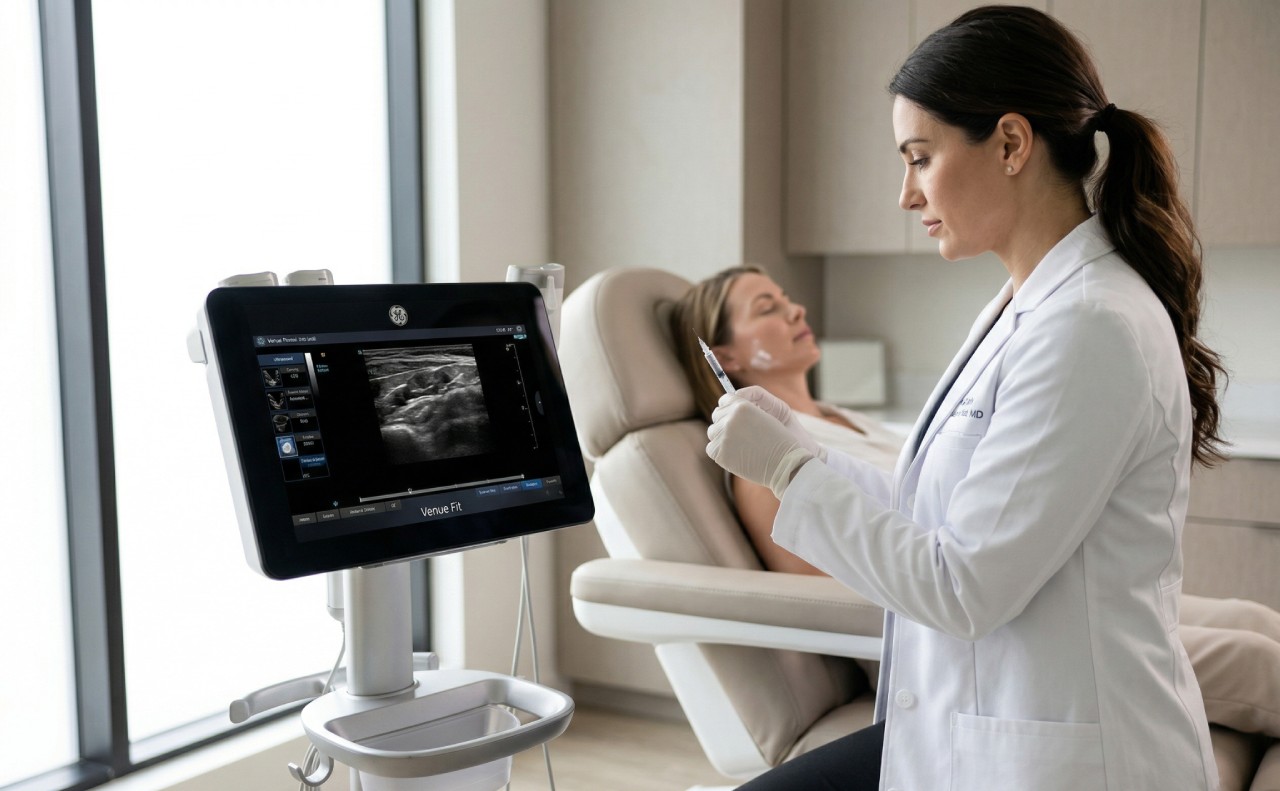
Most people hear the word ultrasound and think of pregnancy scans. In aesthetic medicine, the idea is different but just as useful. An ultrasound-guided injection uses a handheld transducer to send high-frequency sound waves into tissue. The machine turns those sound waves into live images, so your injector can see tissue layers, filler, and nearby structures while treating you.
That is a big change from regular injections. In a standard filler treatment, even a skilled provider relies on anatomy knowledge, landmarks, touch, and experience. Those things still matter, a lot actually, but direct visualization adds another layer of safety. It lets your injector see where the filler should go, where the needle is inserted, and what structures may be in the path. Froedtert explains that ultrasound lets clinicians see tendons, ligaments, muscles, joints, blood vessels, and nerves in real time, which helps them avoid important surrounding structures during a procedure.
This technology did not start in cosmetic care. It has a long history in sports medicine, pain management, and musculoskeletal treatment. It is used for joint injections, aspiration, corticosteroid injection, steroid injections, local anesthetic placement, platelet-rich plasma, prolotherapy, and work around the hip joint, knee joint, bursa, ligament, tendon, and peripheral nerve. Medical literature describes ultrasound-guided injections for joint, muscle, tendon, nerve, ganglion, and bursa conditions, and notes that local anesthetics and corticosteroids are common injected medications.
That background matters because it shows this is not some trendy add-on. It is a medical imaging tool with real clinical use. In aesthetics, we apply the same logic to filler, dissolving, and treatment planning. We are not treating arthritis, bursitis, tendonitis, or labral tears at Akari Med Spa. But the same principle applies. When you can see tissue clearly, you can treat it more carefully.
Introducing the GE Venue Fit System
The device matters too. GE HealthCare describes Venue Fit as a small but powerful point-of-care ultrasound system with a compact footprint, a 14-inch touch screen, and imaging tools built for real-world clinical use. It is also listed by GE for Aesthetics and Musculoskeletal (MSK) care areas, which makes it especially relevant for a med spa that wants high-quality imaging without bringing in oversized hospital equipment.
For facial treatments, image quality is everything. The face has many small, layered structures packed into a tight space. A system that gives clear, real-time images helps your injector assess depth, follow the treatment plane, and avoid mistakes. GE notes that Venue Fit is designed for fast, confident diagnosis and offers configurable probe access and a compact setup that can fit different clinical rooms.
That works well for Akari’s style of care. This practice focuses on refined results, not overdone changes. A clear image supports that goal. When your provider can scan, map, and reassess during the visit, the treatment becomes more exact. It feels more thoughtful, too, which patients notice right away.
How Ultrasound Guided Injections Work
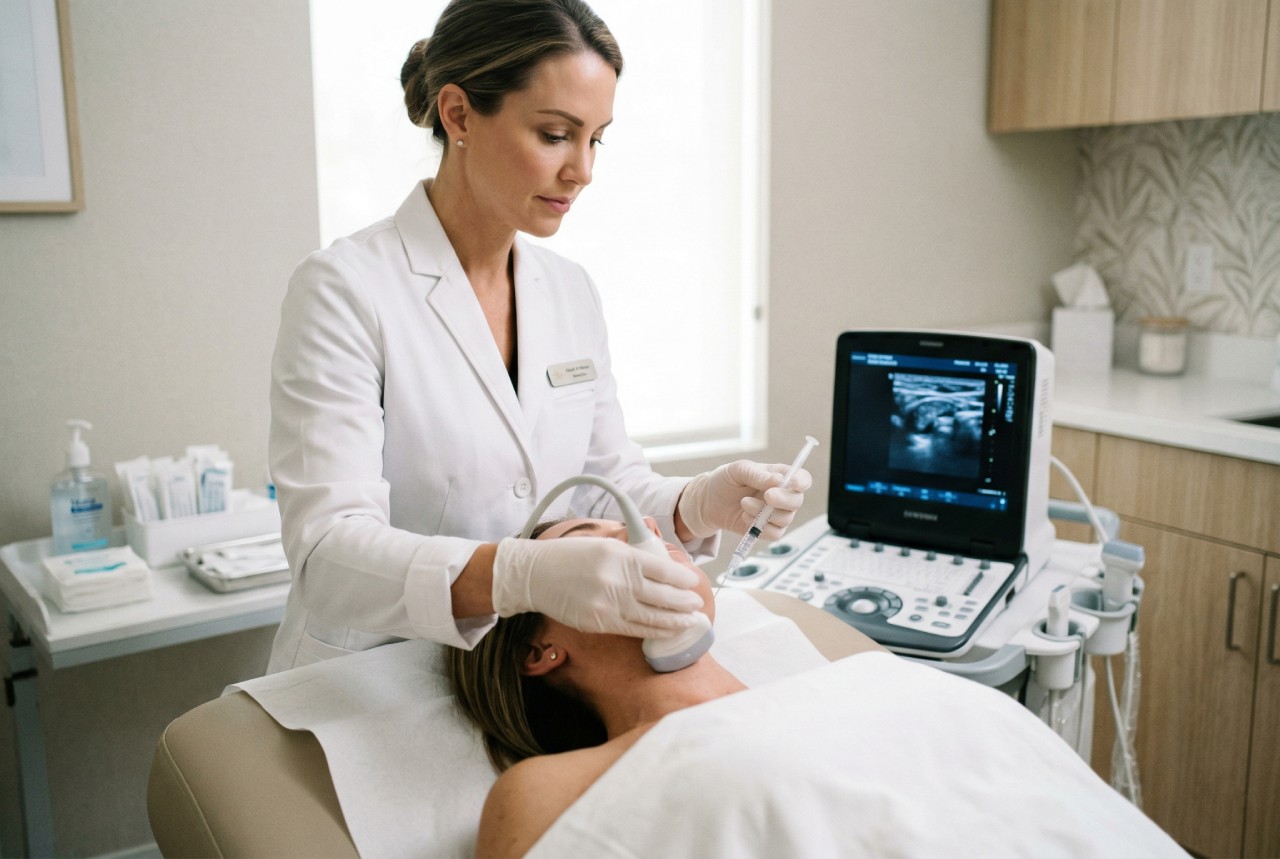
The process starts before anything is injected. Your provider first uses the ultrasound machine to scan the area and study your anatomy. This part is often called mapping. It helps identify where filler may already sit, where key vessels run, and which tissue layer is best for treatment. In facial work, that can be very important in the tear trough, cheeks, and nose, where anatomy can vary a lot from one person to the next. High-frequency ultrasound literature on facial fillers stresses the value of scanning before and during injection to help achieve safe filler placement.
Next comes live guidance during the actual injection. Your provider uses the transducer on the skin while guiding the needle into the planned area. If the angle is off, depth is not ideal, or a vessel appears close by, the path can be changed immediately. That is the part patients usually find reassuring. It is one thing to hear your injector knows anatomy. It is another thing to know they can see it.
After placement, the area can be checked again. This post-treatment scan helps confirm that the filler sits where it should, not where it should not. In correction cases, ultrasound can also help identify old product, migration, or areas that may need hyaluronidase rather than more filler. A recent paper on ultrasound-assisted management of filler-related complications reported that ultrasound can help identify filler-related issues that are difficult to manage by exam alone.
Benefits of Ultrasound-Guided Injections
So what really makes ultrasound-guided injections different, and why are more patients starting to ask for it?
Safer Injections with Real-Time Vessel Avoidance
The biggest benefit is safety. Facial filler complications are uncommon, but when they happen, they can be serious. A 2024 review of dermal filler adverse effects notes that vascular complications can lead to ischemia, tissue necrosis, and, in severe cases, vision-related injury. That is why avoiding vessels is not optional; it is one of the most important parts of the job. (PMC)
More Accurate Needle Placement and Filler Positioning
The next benefit is accuracy. Ultrasound helps your provider place hyaluronic acid filler in the right plane instead of relying on feel alone. The same facial ultrasound review explains that high-frequency ultrasound offers real-time, radiation-free visualization of facial anatomy and may help reduce vascular occlusion, Tyndall effect, edema, and other complications by supporting correct treatment plane selection.
Better Aesthetic Results That Look Natural
There is also a cosmetic benefit. Better placement usually means cleaner contours, less overfilling, and less need for correction later. You want your result to look like you, just fresher and more rested. That is way harder to get when placement is imprecise. Good imaging does not replace injector skill, but it can make skilled work even better.
Quick Comparison Table
| Approach | What your provider sees | Radiation | Best use |
| Traditional injection | Surface landmarks and touch only | None | Straightforward cases, experienced hands |
| Fluoroscopy guided injection | X-ray-based view, less soft tissue detail | Yes | Common in some pain and joint procedures |
| Ultrasound guided injection | Real-time view of soft tissue, filler plane, and nearby vessels | None | Facial filler, correction cases, and areas needing more control |
Mayo Clinic states that ultrasound shows fluid and soft tissue more clearly than fluoroscopy and avoids radiation exposure. Ultrasound allows providers to avoid blood vessels and nerves during injections.
Who Is a Good Candidate for Ultrasound Guided Injections in Newport Beach?
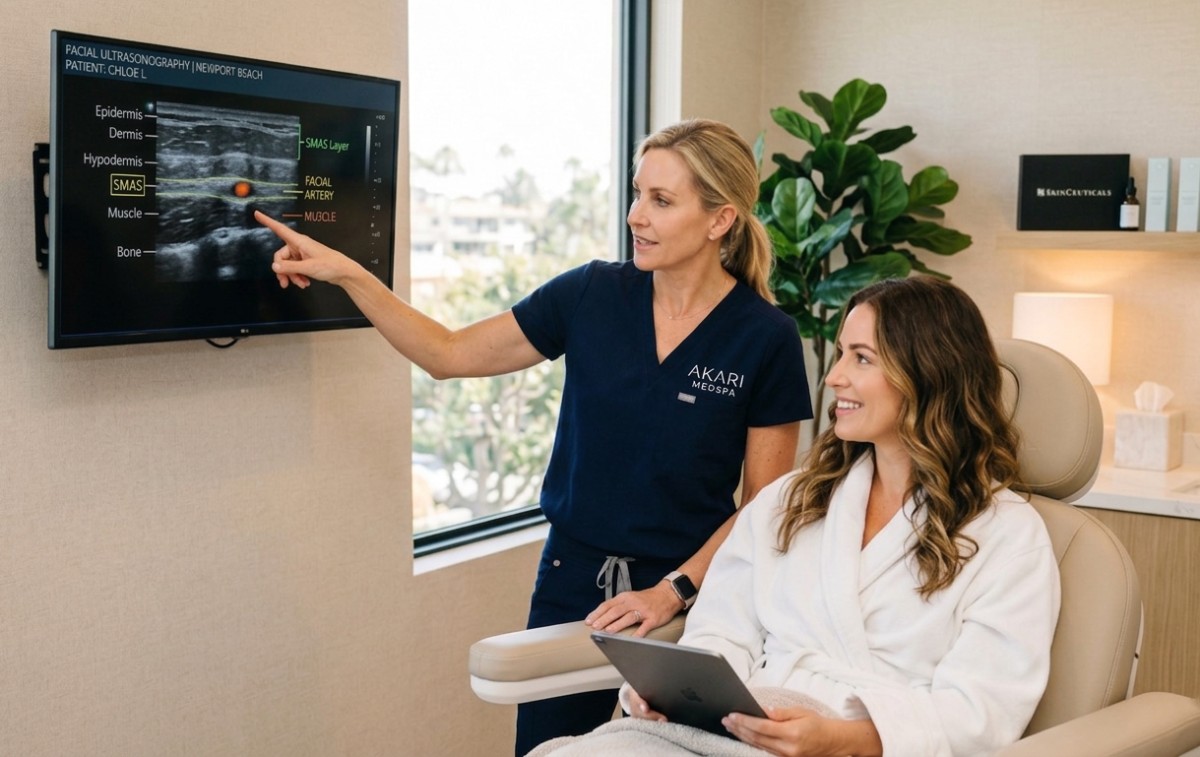
If you are new to filler, this can be a smart place to start. First-time patients often worry about looking fake, getting too much product, or ending up with asymmetry. That fear is normal. Ultrasound guidance adds a level of control that can make the process feel less uncertain.
It is also very useful if you have had filler before and something does not feel right. Maybe you see puffiness under the eyes. Maybe the area looks uneven. Maybe you were told dissolving is the next step, but nobody could say exactly where the old filler is. Ultrasound can help find retained product and guide the next move more precisely.
This approach is especially worth discussing for delicate areas. The tear trough, nose, lips, temples, and midface all sit near important blood vessels and nerves. In those spots, more information is always better.
Facial Areas That Benefit Most
The under-eye area is near the top of the list. Tear trough filler can look beautiful when done well, but it can also swell, look blue, or sit too superficially when done poorly. High-frequency ultrasound guidance in this area helps the injector choose the proper depth and avoid structures that raise risk.
The nose is another major one. Non-surgical rhinoplasty can produce striking changes with a tiny amount of product, but the anatomy is unforgiving. The same facial ultrasound paper highlights the nose and midface as regions with critical vascular anatomy where ultrasound can support safer filler placement.
Cheeks, temples, and lips can benefit too. In cheeks and temples, the goal is often to support and contour without puffiness. In lips, the goal is shape and balance without migration. Again, it comes back to one thing: knowing exactly where the product is going.
What to Expect at Akari Med Spa in Newport Beach
Your visit should start with a consultation, not a sales pitch. Your provider should ask what bothers you, what you want to keep natural, and whether you have had filler, PRP, or other injectable treatment before. Then comes the scan. That first look helps shape the plan.
During treatment, the area is cleaned, and the procedure is done in an office setting under sterile conditions. Froedtert notes that ultrasound-guided injections are commonly done in the office and usually take about 20 to 40 minutes, depending on the area. In aesthetic care, timing depends on the complexity of the treatment and whether mapping or correction is involved.
Downtime is usually limited, though it depends on the product used and the area treated. Most people return to normal activities fairly quickly. Your injector may still tell you to avoid pressure on the treated area, intense exercise for a short period, or anything else that could shift product while tissue settles.
FAQs
1. What makes an ultrasound-guided injection safer than a regular injection?
It gives your provider real-time visualization of tissue and nearby structures. That helps with accurate needle placement and helps avoid blood vessels that may be in the path.
2. Does ultrasound make the injection more painful?
No, not usually. The scan itself is painless. The injection feels similar to other filler treatments, though your provider may use numbing methods depending on the area.
3. Is this only for difficult cases?
No. It can help first-time patients, correction cases, and delicate areas. It is not only for emergencies or complicated filler dissolving.
4. Can ultrasound detect old filler?
Yes. It can often help identify retained filler, migration, or areas that may need to be dissolved rather than filled again.
5. Is ultrasound better than fluoroscopy or X-ray for facial fillers?
For soft tissue visualization, yes. Mayo Clinic and Froedtert both note that ultrasound gives real-time soft tissue detail and avoids radiation exposure, while fluoroscopy relies on X-ray imaging.
Conclusion
Good filler work should not feel like guesswork. You want a plan, a clear eye, and a provider who can read your anatomy instead of pushing product and hoping for the best. That is the real value of ultrasound-guided injections with GE Venue Fit. They bring live imaging into the room, improve precision, and support safer decision-making from start to finish.
At Akari Med Spa in Newport Beach, that approach fits the bigger goal. You still want soft, natural-looking results. You still want treatment that respects your features. The difference is that now your injector can pair experience with real-time ultrasound guidance, and that is a pretty big deal.
If you have been thinking about injectables but want a safer, more precise approach, this is a good place to start. Schedule a consultation at Akari Med Spa to discuss your goals, review your anatomy with ultrasound, and build a treatment plan that actually makes sense for you.

Isabel “Izzy” Koo, MSN, NP-BC, leads Akari Medspa with a focus on integrity, artistry, and precision. As a board-certified nurse practitioner with advanced training in aesthetic medicine, she focuses on subtle enhancements that bring out each client’s natural features. Her careful approach and strong sense of balance help turn every treatment into a thoughtful, personalized experience built on trust.